Process
Technical Insights
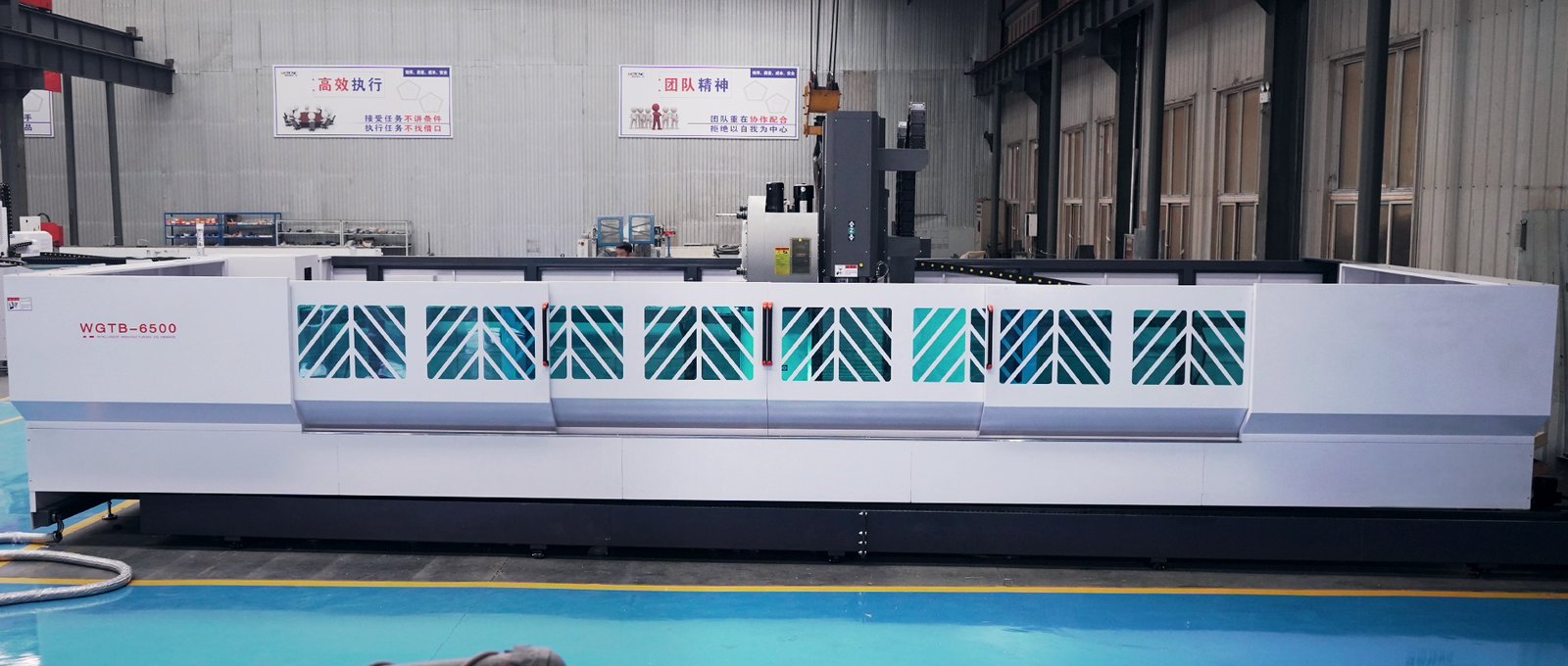
A rail vehicle side wall or floor profile is a different animal from a window profile. It arrives as a 6 to 12 metre multi-cavity extrusion in 6000-series aluminium, often 400 to 800 mm wide, with walls between 2.5 and 5 mm, and a hole pattern that runs the full length with mounting points for insulation, cable trays, seat rails and weld preparation. The machining problem is dominated by length and by the fact that the part is flexible in every direction except along its own extrusion.
1. What actually makes these parts hard
Three characteristics drive every machine decision. First, the length: a 12-metre profile cannot be machined in one setup on a 6.5-metre machine, so either the work is split or the table is longer. Second, the wall thickness: a multi-cavity extrusion deflects under clamping and under cutting force, and the deflection is not uniform along the length. Third, the accuracy requirement is expressed over a span — hole positions relative to each other across six metres — which is a different problem from repeatability at one point.
- Length distribution: how many parts are under 6.5 m and how many exceed it
- Wall thickness at the clamping zone, and whether the cavities are closed or open
- Whether the hole pattern is symmetric and can be split into two setups
- The tolerance that matters: point-to-point repeatability, or absolute position over the full length
2. Stroke and stations: where the cost sits
The instinct is to buy the longest table available. That is often the wrong trade. A 6.5-metre machine with two stations can machine one part while the operator loads the next, which recovers more spindle time than a longer table used sequentially. Only when parts genuinely exceed the stroke does the longer table become mandatory.
Configuration boundaries for rail profiles
| Situation | Configuration | Trade-off |
|---|---|---|
| Profiles up to 6.5 m, medium volume | WGTB-6500, 6,500 mm travel | Single setup, 650 mm Y covers most body profiles; two-station work needs planning |
| Profiles up to 6.5 m, high volume | Two-station layout with pendulum loading | Highest spindle utilisation; needs floor space and a loading plan |
| Wide body panels, 1.6 m class | WGTC-3016, 3,000 × 1,600 mm table | Wide Y travel, gantry stability; length limited to 3 m per setup |
| Very long or large gantry work | WGTC-3027, 10,000 mm X, 2,300 mm Y | Handles long and wide at once; larger footprint and power demand |
3. Clamping a multi-cavity extrusion without distorting it
Clamp a hollow extrusion at two points and it bows; clamp it hard and the cavities collapse locally, which shows up later as a weld gap. The practical approach is distributed clamping on the solid web between cavities, with support blocks set to the same height along the length, and clamping force kept just high enough to prevent lifting during cutting rather than high enough to feel secure.
- Support the profile along its full length, with adjustable blocks set to a straight edge, not to the floor
- Clamp on the web between cavities, never across a cavity wall
- Use several low-pressure pneumatic clamps rather than two heavy ones
- Check flatness after unclamping on the first part of every batch — distortion shows there first
- For weld-preparation cuts, verify the bevel angle and the remaining land after machining, not just the hole positions
4. Accuracy over a long span is a measurement problem first
A machine can hold ±0.05 mm at one point and still miss a six-metre hole-to-hole requirement, because the error budget includes scale error, thermal growth over the length, and how the part was supported. Three practices close the gap: measure the machine's actual positioning error along the full stroke rather than trusting the specification, keep the workshop temperature stable during long parts, and verify the first article on a CMM or a laser tracker with the part supported the same way it will be in assembly.
For rail work, it is also worth asking for the compensation data: a machine with linear-scale feedback and pitch-error compensation behaves differently over ten metres than one relying on the screw or rack alone, and the difference is measurable in the first article.
5. Cycle time and changeover on a low-volume, high-mix line
Rail contracts rarely run high volumes per variant: a few dozen of each profile, then a new drawing. That makes changeover and programming the real bottleneck, not the cutting speed. A profile with 400 holes at 1.5 seconds each is ten minutes of cutting; a two-hour setup dominates it entirely.
- Store fixture offsets per drawing number so a repeat order starts from a known state
- Keep the clamping layout identical across a profile family, so operators do not relearn it
- Program from the drawing's hole table rather than teaching each hole at the machine
- Batch the same hole size across the part, so the tool change count drops
6. What to send with a rail enquiry
- Profile drawing with cavity geometry and wall thickness
- Length distribution and annual quantity per variant
- Hole table, including any weld-preparation or bevel features
- The tolerance that the assembly jig actually enforces, and how it is measured
- Loading method: overhead crane, roller conveyor, or manual — it changes the table and station layout
Frequently asked questions
- Can a 6.5 m machine handle a 12 m profile in two setups?
- Yes, if the hole pattern can be split at a defined datum and the part can be re-clamped without introducing a step. The risk is not the machining but the re-datum: the second setup must reference the first setup's features, and the joint area should be checked for step and twist. For high volume, a longer table or a travelling gantry is usually cheaper than living with two setups.
- How do I stop a hollow extrusion from collapsing under clamping?
- Clamp on the solid web between cavities, distribute the force across several low-pressure clamps, and support the full length. If the wall is under 3 mm, ask for a fixture with contoured jaws that follow the profile rather than flat jaws.
- Is repeatability or absolute accuracy more important here?
- For hole-to-hole spacing within one part, absolute accuracy over the span matters more; repeatability matters for batch consistency. Ask for both figures and for the compensation method, because a ±0.05 mm repeatability claim says nothing about a six-metre span.
- Do I need linear scales for rail work?
- For long parts with tight span requirements, closed-loop linear feedback plus pitch-error compensation is the reliable route. It costs more up front and is difficult to retrofit later, so decide before ordering rather than after the first rejected first article.
Rail enquiries are usually answered with a fixturing concept and a span-accuracy plan, not just a model number. Send the profile drawing and the hole table, and tell us how the part is loaded — that single detail changes the recommended configuration more than anything else.