Selection
Technical Insights
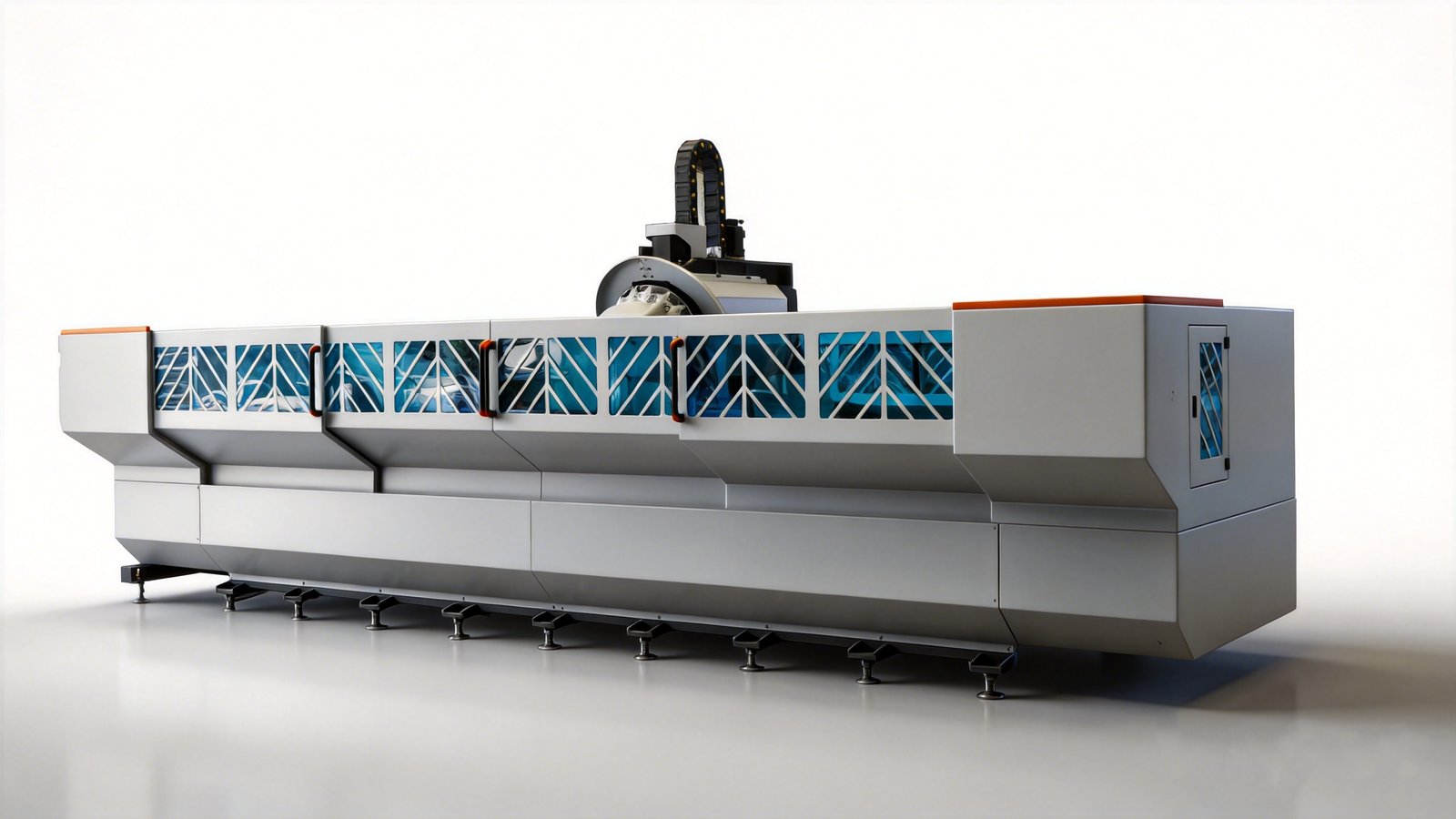
Profile work is rarely as uniform as it looks on paper. One plant may cut 3 m aluminium frames in the morning, handle 6 m steel beams in the afternoon, and take on end-of-life battery pack dismantling next year. Choosing a machine is therefore seldom a question of which one is "better", but of which one fits and whether it can still cover your order mix two years from now. This guide breaks the decision into four layers: define the workpiece, understand how the models divide the work, specify travels, spindle and magazine, then confirm delivery and support.
1. Define the workpiece before the machine
Most bad selections come from doing this in the wrong order: reading the spec sheet first, then trying to fit the workpiece to it. Reverse it — measure the physical limits of your work first.
- Workpiece length sets the X travel; allow 200–300 mm at each end for fixturing, end-face work and clearance
- Section width and height set the Y and Z travels; multi-face work also needs room for tilting or indexing
- Unit weight sets the table load — long parts usually hit the weight limit before they hit the length limit
- Material sets the spindle character: aluminium wants speed and chip evacuation, steel wants low-end torque and rigidity
- The operation list sets the number of tool pockets — milling, drilling, chamfering and tapping in one setup needs that many resident tools
2. How the five models divide the work
The five models are separated along three axes — material, workpiece scale and operation mix. They overlap, but each has a home ground.
01 WGT-3000G | Four-axis fibre-laser combined centre. For industrial aluminium and copper profiles and U-PVC sections, it completes fibre cutting, milling, drilling and chamfering in one setup. The table tilts anywhere between -90° and +90°, so multi-face features need no second clamping. X travel 3000 mm — suited to complex light-alloy sections with mixed operations at moderate length.
02 WGTA-4500 | Three-axis combined centre (BT30). Works both steel and aluminium. The BT30 taper balances rigidity and speed at up to 12000 rpm, and a 16-station carousel magazine changes tools in about 2 seconds. X travel 4500 mm. This is the general-purpose machine for shops whose order mix keeps changing.
03 WGTB-6500 | Heavy-duty three-axis centre (BT40). X travel 6500 mm, table load up to 5000 kg, BT40 spindle with 7.5 kW of cutting power, slat-type automatic chip conveyor for long unattended runs, and a 24-station arm-type magazine at about 1.8 seconds per change. Built for large, heavy workpieces and heavy cuts in steel.
04 WGTC3016 | Gantry battery-pack dismantling centre (BT40). For dismantling and re-machining of EV battery trays, pack frames and housings, including milling of bottom protection plates, base shells and cell tabs. X travel 3000 mm, Y travel 1600 mm, table 3000 × 1600 mm, up to 16000 rpm, 12-station umbrella magazine at about 1.8 seconds per change.
05 WGTC-3027 | Fully enclosed explosion-proof gantry centre. For tab cutting and milling of retired traction battery packs. The work zone is fully enclosed with an isolation door and continuous extraction; if a fire starts, the table moves automatically to a safe position for spray cooling and then descends into a 304 stainless steel water tank — the full sequence responds within about 3 seconds. X travel 10000 mm, table 2000 × 2700 mm, accepts packs from 800 to 2500 mm, BT40 24-station arm magazine at 2.2 seconds, with interfaces reserved for CCD, 3D vision and laser line scanning.
3. Four typical applications and where to start
Matching the application to a model shortens the decision considerably. These four cover most enquiries.
- Aluminium frames, automation guarding, display stands: mixed sections, small batches, bottleneck is changeover and programming → start with WGT-3000G or WGTA-4500
- Solar frames, door and window profiles: fixed lengths, high volume, bottleneck is cycle time and continuous running → start with WGT-3000G or WGTB-6500
- Steel structures, beams and heavy sections: heavy loads and heavy cuts → WGTB-6500
- Battery tray production and end-of-life pack dismantling: safety first, requiring enclosure, extraction and automatic fire suppression → WGTC3016 and WGTC-3027
4. Choosing travels, spindle and magazine
These three are the easiest to overspecify. Each carries its own cost: over-specified is money wasted, under-specified is a permanent bottleneck.
- Travels: size to your longest part plus clearance. Do not buy extra travel for the occasional job — ask instead whether a longer bed can be built to order
- Spindle: for aluminium look at maximum speed and the power curve; for steel look at low-end torque and taper size. BT30 is the flexible option, BT40 the rigid one
- Magazine: count the tools your regular operations actually need. Eight to twelve covers most work, and an oversized magazine simply lengthens the tool-change path
- Change time: at volume this compounds fast. The gap between 1.8 s and 3 s over several thousand changes a day is real capacity
5. Where accuracy actually comes from
The positioning figure on the brochure is measured on a new machine. Repeatability in production comes from other things.
- Bed: high-grade cast iron, stress-relieved, so thermal growth stays small and accuracy holds
- Drives: the make and size of the core drive and guide components decide how fast accuracy decays with wear
- Cooling and chip removal: chip build-up and temperature rise are common causes of drift — automatic chip removal and adequate coolant are not optional extras
- Fixturing: no machine survives repeated re-indicating. Modular fixtures with locating pins do more for accuracy than another micron on the spec sheet
- Inspection: first-piece checks plus sampling of critical dimensions, with the deviation trend recorded, costs less than full inspection downstream
6. Delivery, commissioning and support
Arrival of the machine is the start, not the finish. Output is decided by commissioning and what happens afterwards.
- Before delivery, confirm foundations, power capacity, air supply, and chip and fume extraction against the technical requirements
- On-site installation and commissioning typically takes one to two days, including test cuts and operator training
- Machine warranty is 12 months; consumables and spare parts should have stated lead times
- Programming and process support: confirm whether the supplier provides program writing, process proposals and remote assistance
- For export orders, confirm voltage and frequency, applicable safety standards, and documentation (manual, certificate of conformity, packing list)
Key specifications compared
| Model | Primary role | X / Y / Z travel (mm) | Spindle | Tool magazine | Typical work |
|---|---|---|---|---|---|
| WGT-3000G | Precision light-alloy multi-process | 3000 / 350 / 300 | Milling spindle 9 kW · 24000 rpm + 3 kW fibre laser | Combined: cut, mill, drill, chamfer in one set-up | Industrial aluminium, copper and U-PVC profiles |
| WGTA-4500 | General steel and aluminium profiles | 4500 / 450 / 400 | BT30 · 5.5 kW · 12000 rpm · 45 N·m | 16 tools · disc type | Mixed steel/aluminium profiles, frames, ladders, guardrails |
| WGTB-6500 | Large heavy-duty work | 6500 / 650 / 500 | BT40 · 7.5 kW · 12000 rpm · 52.5 N·m | 24 tools · arm type | Long steel beams, heavy frames, construction machinery profiles |
| WGTC3016 | Battery pack dismantling | 3000 / 1600 / 500 | BT40 · 16000 rpm | 12 tools · umbrella type | Retired pack covers, module frames |
| WGTC-3027 | Explosion-proof tab cutting | 10000 / 2300 / 600 | BT40 · 11 / 15 kW · 15000 rpm | 24 tools · arm type | Live-pack tab cutting, terminal and busbar milling |
Frequently asked questions
- How many conventional machines can one machining centre replace?
- It depends on which operations you are replacing. Where sawing, drilling, milling and tapping currently run as four separate operations on four machines, one centre that does them all in a single setup typically covers three or four of those steps and removes the handling and re-datuming between them. For a firm number, have a test cut done on your own parts.
- Mostly steel, some aluminium — BT30 or BT40?
- If steel dominates and cuts are heavy, choose BT40 for rigidity and torque. If aluminium and thin-wall work dominate and you want speed and surface finish, BT30 is the better fit. Where both are regular, decide by whichever material carries the larger share.
- Is a dedicated machine really necessary for battery pack dismantling?
- Retired packs retain energy, and tab cutting and milling carry a fire risk. A general-purpose centre has no enclosure, extraction or automatic suppression. Wherever dismantling is done on a live pack, use a machine designed with explosion protection and automatic fire suppression, plus written procedures and on-site fire provisions.
- Can we run it without a dedicated programmer?
- Yes. Choose a control with graphical programming and process templates, and ask the supplier for initial training and to write the first programs. Once your common sections are saved as templates, shop-floor operators can call them up and edit them themselves.
If your work spans several materials and lengths, start by listing a typical year of parts — length range, section sizes, materials and batch quantities — then work down the four layers above. Send us that list and we will come back with a machine and fixture proposal, or arrange a test cut on your own workpieces.