Process
Technical Insights
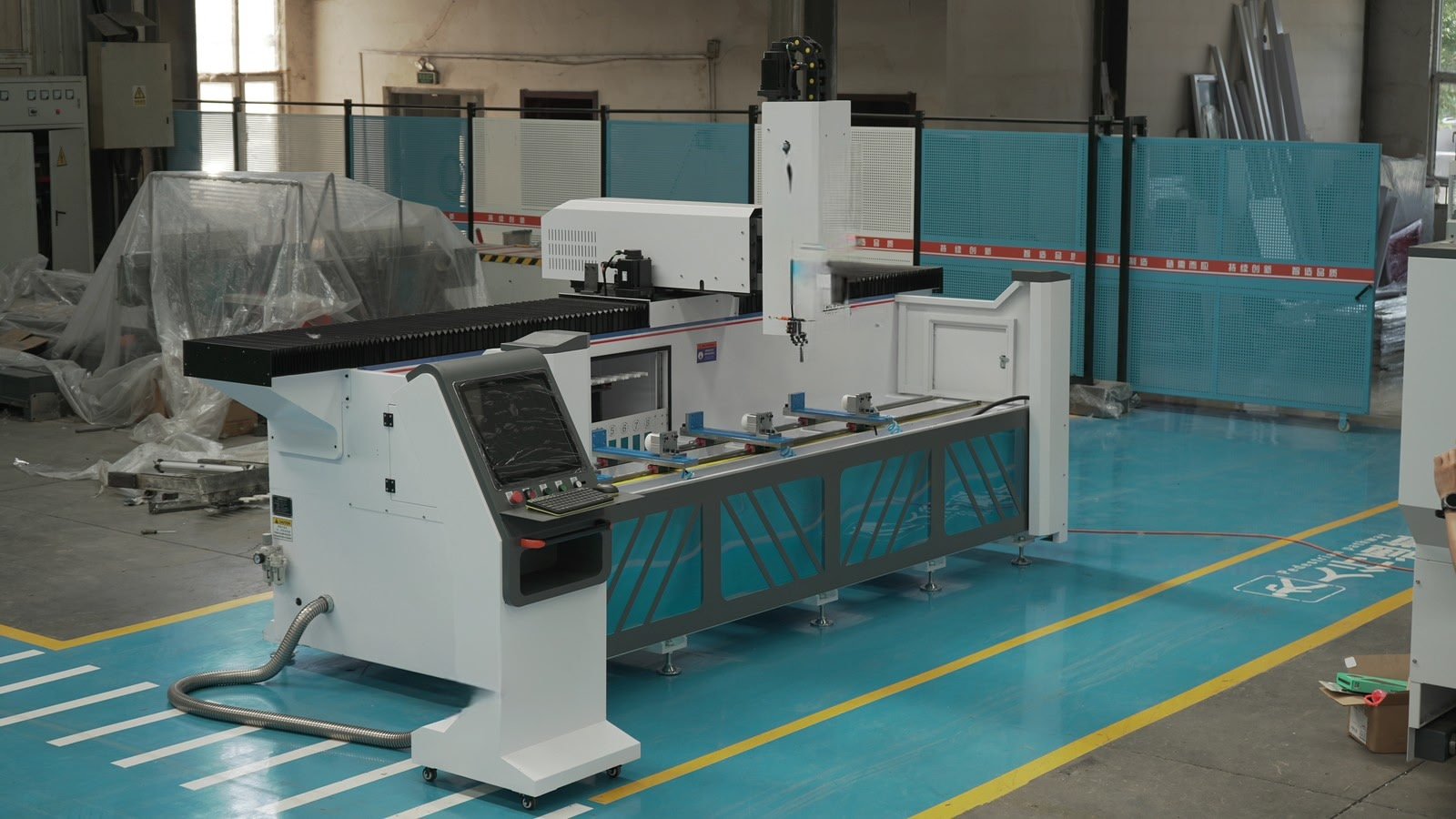
LED channel profiles (linear lighting extrusions) are among the most machine-critical appearance parts: dozens to hundreds of specifications, batches often just a few hundred metres, and a surface quality — including the diffuser slot — that the end customer sees directly. Common pain points in channel shops are saw-cut burrs, a second setup just to face the ends, and no machine at all for mitre cuts or shaped end caps. These are precisely the home ground of one-setup combined machining.
1. Typical features of LED channel work
- Cut-to-length: from 0.5 m to 3 m, with a dozen different lengths of the same section in a single day
- End features: square cuts, 45° mitres (for inside/outside corners), T-joint slots, end-cap grooves
- Mounting and suspension holes: modular pitch, moderate tolerance but large quantity
- Diffuser-slot deburring: any burr left inside the slot becomes a bright line under the light — the number-one customer complaint
2. Surface quality: the real entry barrier
Dimensional tolerances are usually achievable; the barrier is the invisible quality:
- Cut-face finish: a sawn, burred face shows as a dark line at the LED strip joint — one milling pass fixes it, provided there is no second setup
- Diffuser-slot inner wall: milling marks and burrs are amplified by diffuse reflection, so finish with high helix tools, high rpm and light depth of cut
- Surface scratches: ordinary clamps and V-blocks mark anodised surfaces — every contact point needs soft inserts
- Remnant management: with high mix, every specification leaves different offcuts; parameterised programs let you consume the last usable length of every remnant
3. High-mix production: changeover beats cutting speed
A dozen changeovers per day is normal in a channel shop. The evaluation order for equipment should be: can programs be parameterised and recalled (length, hole pitch, end type as arguments); does changeover require re-datuming; and only then, spindle numbers. This is exactly the logic of the WGT-3000G — the 4-axis tilting table completes end features in one setup, and the optional 3 kW fibre merges cutting-to-length and hole drilling into one operation, leaving changeover as nothing but parameter changes.
LED channel operations mapped to the WGT-3000G
| Operation | Traditional pain point | WGT-3000G mapping |
|---|---|---|
| Cut-to-length | Saw burrs; ends need re-work | Milling or 3 kW fibre cut — face is finished as-cut |
| 45° mitres / shaped ends | Impossible on general machines or needs dies | -90° to +90° tilting table, formed in one setup |
| Diffuser-slot finishing | Burrs show as bright lines under light | 9 kW high-speed spindle finishing, single setup |
| Mounting hole drilling | Marked-out positions drift batch to batch | Programmed grid — identical within and across batches |
| End-cap groove milling | Multiple operations on multiple machines | Same setup; cycle time consolidated |
Frequently asked questions
- Should channels be sawn or milled to length?
- On cut-face quality, milling or laser cutting clearly beats sawing: a burr-free face joins straight to the LED strip. Sawing wins only on equipment cost, and that saving comes back doubled as manual end-face rework. For medium and high volumes, plan the line around one-setup cutting plus end features.
- Can anodised profiles still be machined?
- Yes, but sequence matters: where possible, machine before anodising. If machining anodised stock is unavoidable, use soft contact pads, sharp tools, high rpm with light depth of cut, and control coolant to avoid whitening the anodised surface.
- With hundreds of specifications, will program management get out of hand?
- Not if managed as model = parameter set: length, hole pitch, end type and slot width are all arguments, indexed by model. A new specification is one new row. Ask the manufacturer to demonstrate parameterisation against your own model list during acceptance testing.
- Is the WGT-3000G's 3000 mm stroke enough?
- Most channel workpieces are under 3 m, so 3000 mm covers the overwhelming majority; longer stock can be accommodated by extending the stroke to order — no need to change machine class.
Send three to five of your most common channel sections with their length lists, and we will run a cycle-time estimate and a parameterised-program demonstration on your own specifications. In high-mix production, the ledger is counted in changeovers, not in spindle rpm.