Process
Technical Insights
Aluminium formwork (6061-T6 flat panels and extruded frames) follows a different logic from most profile work: holes are not designed panel by panel but placed on a standard grid per the project standard — tie-rod holes, pin holes and wedge holes all land on the same modular grid. One panel set rotates through dozens of construction sites, and every refurbishment may add, enlarge or reposition holes. Formwork producers therefore show three distinct traits: enormous batches, a highly standardised hole system, and a large refurbishment share.
1. Hole-grid planning: a one-time investment in grid and datum
- Fix the grid module first (100 / 200 mm are common) so every hole sits on a grid intersection — this is what makes programs parameterisable
- Separate the three accuracy classes: tie-rod holes (tightest position tolerance), pin holes (reamed to fit), clearance holes (loose)
- Put panel locating datums on the same two edges for all panel types — cheapest to re-establish during refurbishment
- Manage drawings and programs as grid + hole table: a new panel type = same grid call with a different table, no re-programming
2. Refurbishment: the second growth curve
Formwork cycles 200+ times, and refurbishment (re-drilling after straightening, trimming and repair) is one of the steadiest profit sources for a formwork plant. Refurb work means small per-panel volumes, mixed batches and distorted incoming material — exactly where a machining centre beats a general-purpose drill press: position comes from fixtures and program, and warped panels recover their datum on adjustable supports.
- Straighten before the machine; put the straightening station next to the machining centre
- When old holes miss the current grid, align by work-offset (G54 shift) — never by manual marking
- Standardise repair holes to the standard pin-hole size so panels do not drift further from spec with every cycle
3. Throughput: the formwork ledger lives in batch handling
A standard 1200×3000 mm panel carries 30–80 holes and takes only a minute or two of cutting; the time really consumed is loading, unloading and flipping. So the selection priorities for a formwork plant are not spindle speed but: can the table take two panels at once, are supports and clamps designed for flat panels, and does flipping need a crane.
Formwork operations mapped to the WGTA-4500
| Operation | Key point | Machine mapping |
|---|---|---|
| Tie-rod hole drilling | Tightest position tolerance, grid-intersection locating | BT30 · 5.5 kW · parameterised grid |
| Pin hole drilling + reaming | Reamed for smooth pin insertion | Drill and ream in one setup — no re-datuming |
| Wedge / clearance holes | Loose tolerance; batch speed matters | 12000 rpm high-speed small-hole drilling |
| Edge trimming / milling | Squaring refurbished panel edges | 4500 mm X stroke covers the long edge in one pass |
| Re-drilling refurbished panels | Incoming distortion needs adjustable supports | Multiple supports + work-offset alignment to old holes |
Frequently asked questions
- Panels are flat, not extruded profiles. Will a profile machining center work?
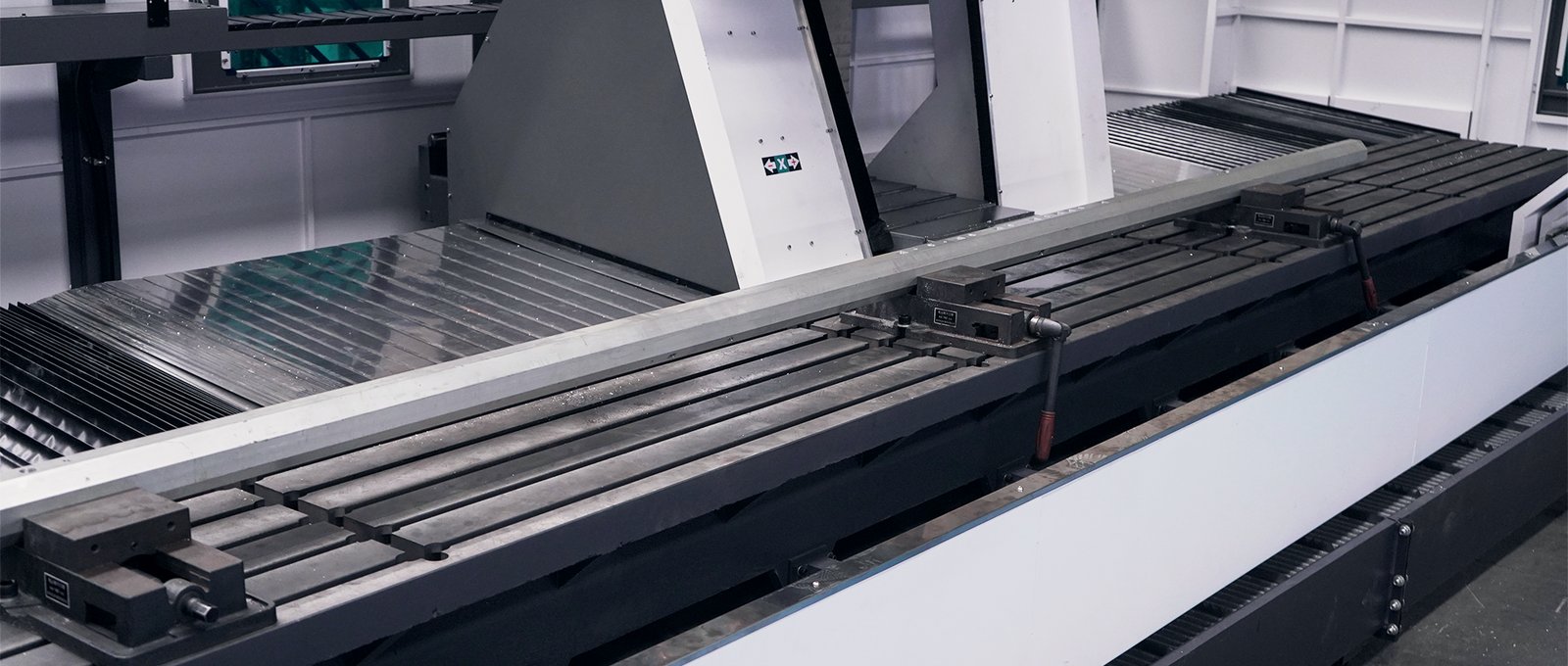
- Yes. Flat panels simply sit on the table with multiple supports; the key is a fixture system designed for flat plates — large-area pressure feet, adjustable support strips, anti-scratch pads. The WGTA-4500's 4500×460 mm table and 3000 kg load easily accommodate standard panels and most frame assemblies.
- Distorted refurbished panels no longer line up with old holes. What then?
- Straighten first, machine second — that is rule one. For residual distortion, use work-coordinate offsets to align the program to the measured old-hole positions instead of manual marking. Fix the refurbishment flow as three steps: straighten → measure old holes → offset machining.
- How many panels can one machine do per day?
- It depends on hole count and flipping method. With 50 holes per panel and manual loading without crane flipping, 200–300 panels per shift is common; the bottleneck is handling, not cutting. To raise output, optimise logistics first and spindle speed second.
- Do we need automatic loading?
- Formwork is high-volume and light per piece, so roller tables or simple manipulators fit well. But run a stable manual line first and collect real cycle data — automation ROI must be judged on measured takt, never on theoretical takt.
Send us your standard panel hole drawing, panel-type list and monthly output, and we will return a fixture layout, a refurbishment workflow and a per-shift capacity estimate. The formwork business is measured in real takt, not brochure numbers.